Megan Longstaff
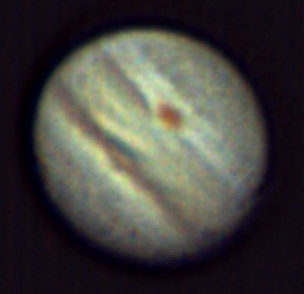
Tracking Jupiter's Great Red Spot
Summer 2018 - Megan Longstaff, Dr. Katrina Hay, Dr. Sean O'Neill
Jupiter's atmosphere is subject to differential rotation in which the bands and zones of the planet rotate at different speeds. The Great Red Spot (GRS) is located 22 degrees south of Jupiter's equator and has a drift velocity which changes its rotational period monthly. We use feature tracking and 2D to 3D mapping techniques to observationally determine the rotation of the GRS and compare it to the expected rotation rate of 11.5 km/s determined by observations of the magnetosphere. Through our analysis we observe the movement of the GRS over multiple nights and construct an average speed based on this data. We determine the average speed of the GRS to be around 10.97 km/s, a 4.60% difference from the expected value.
Investigation of Diblock Nanomorphology with Atomic Force Microscopy for Novel Synthesized Diblock Copolymers with and without Lithium Salt
Summer 2016 - Megan Longstaff, Dr. Dean Waldow
Novel diblock copolymers were synthesized with a ring opening metathesis polymerization reaction for use as solid polymer electrolytes in lithium ion batteries. The polymers were made to decouple the segmental motion from ionic conductivity with a bulky backbone to make faster and safer batteries while also preventing dendrite formation in the electrolyte. All polymers featured varying compositions and lengths of the same two blocks that shared an identical backbone. One monomer had a phenyl group at the end to provide rigidity and support and the other had an oligomeric ethylene oxide (EO) chain for ionic conductivity. Atomic force microscopy was used to determine the nanomorphology of the diblocks in bulk and in the presence of bis(trifluoromethane)sulfonimide lithium salt. The ordering of the polymer and only spin coating was poor, but solvent vapor annealing was used to induce and reinforce order throughout the sample. Salt improved the ordering of samples and showed similar results to when polymers were relaxed with solvent vapor annealing. A combination of salting and annealing was also studied and showed to preserve order or induce longer range ordering in samples. Each different composition of polymer showed unique results and ordering. Testing the conductivity is the next step in determining the success of the polymers as electrolytes, but so far they prove to be good candidates to solve current issues with batteries.
Published article: Longstaff, M.; Gardiner, K.; Zhuravlev, R.; Finney, J.; Waldow, D. A. Electrochimica Acta2019, 298, 339–346.